





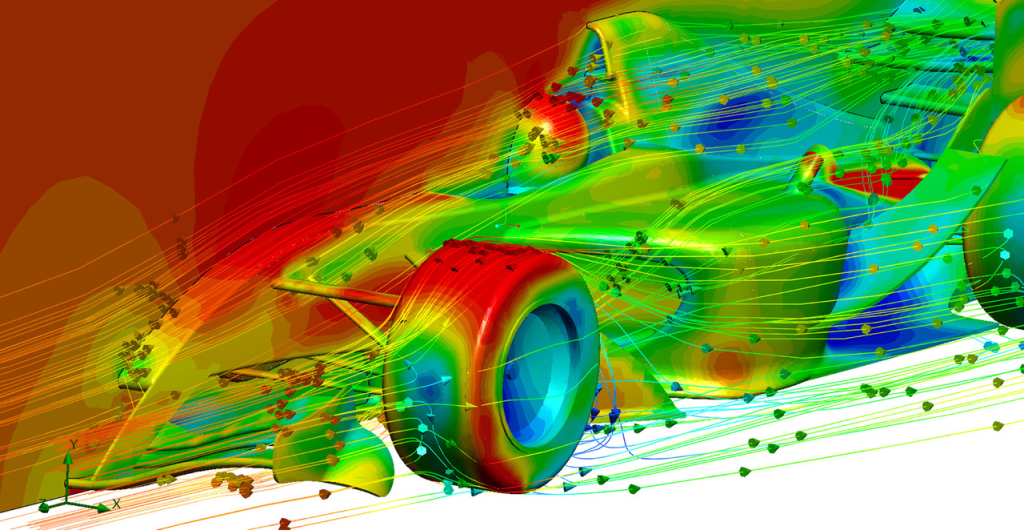
Fluids, such as air and water, are all around us and are very important in daily life and in many fields like engineering, weather study, and building energy analysis. Computational Fluid Dynamics (CFD) is a method used to study how fluids move and behave by using computers. CFD software helps us understand and predict flow patterns in systems like pipes, engines, buildings, and even the atmosphere.
What is a Fluid?
A fluid is any substance that can flow and easily change its shape when a force is applied. Fluids include both liquids and gases. Unlike solid objects, fluids do not keep a fixed shape.
Fluids are made of tiny particles that are always moving. Their movement and how closely they are packed together affect how the fluid behaves.
Liquids
Liquids have a fixed volume but no fixed shape. They take the shape of whatever container they are in. The particles in liquids are close together, which gives liquids some strength and smooth flow.
Examples of liquids include water, oil, and blood. Liquids can form drops and have properties like surface tension and thickness (viscosity).
Gases
Gases do not have a fixed shape or volume. They spread out to fill any space available. The particles in gases are far apart and move freely.
Air, steam, and carbon dioxide are examples of gases. Gases can be easily compressed and are less dense than liquids.
Why Computational Fluid Dynamics is Important
Fluid motion can be very complex. Pressure, speed, temperature, and other factors all affect how fluids move. CFD uses computer methods to solve these complex problems. It helps scientists and engineers see how fluids behave without doing many physical tests.
How CFD Works and Its Uses
Computational Fluid Dynamics follows a step-by-step process to study fluid flow and give useful results for real-world problems.
Steps in CFD Analysis
1. Creating the model
A digital model of the object or system is made. This can be anything like a pipe, a car, or a building.
2. Making the mesh
The model is divided into small parts called a mesh. These small parts help the computer study the flow in detail.
3. Setting conditions
Rules are set for how the fluid enters, leaves, and behaves in the system. This includes speed, pressure, and temperature.
4. Solving the equations
The computer uses math equations to calculate how the fluid moves through each part of the mesh. This step may take time depending on how complex the system is.
5. Viewing results
The results are shown using images, graphs, and charts. This helps users understand how the fluid flows in the system.
Benefits of CFD
CFD has many useful advantages:
- It saves money by reducing the need for physical tests
- It improves safety by testing dangerous situations on computers
- It can be used in many fields and industries
- It gives good and detailed results when done properly
Applications of CFD
CFD is used in many real-life areas:
Aerospace and cars
It helps improve the shape of planes and vehicles to reduce air resistance and save fuel.
Weather and environment
It helps predict weather changes and how pollution spreads in air and water.
Energy systems
It improves the design of wind turbines, power plants, and other energy systems.
Medicine and biology
It helps study blood flow and breathing, and supports the design of medical tools.
Ocean and marine work
It helps study waves, ocean currents, and ship movement.
Building energy analysis
CFD is also used in building design to study airflow, heating, cooling, and energy use inside buildings. This helps create safer, more comfortable, and energy-saving spaces.
Conclusion
Computational Fluid Dynamics is a powerful tool that helps us understand how fluids move in different situations. By using computer models, CFD makes it easier to study complex systems without expensive or risky experiments. As technology improves, CFD will continue to play a big role in science, engineering, weather prediction, and building design.